Small business owners in Kenya and Nigeria signed up in their hundreds for a growth coach. Testing with 7 of them showed what the product had to fix before launch.
424
leads against a target of 200
6 of 7
testers found the AI insights accurate
Team: Product manager, marketing team and meTimeline: Oct 2025 to Feb 2026My role: Value proposition (with the PM), prototype design and build, user testing, landing page build, A/B test setup
The situation
AMI wanted to know whether entrepreneurs would pay for a growth product directly, with no partner programme in between. We called it D2E, direct to entrepreneur.
We had two questions, in order. Is there demand? And if people sign up, does the product give them a reason to come back every week?
Running the demand test
We ran the campaign in Kenya and Nigeria at the same time, so one test answered for both markets. I helped build the landing pages in three weeks, from strategy discussions to launch, and set up the A/B tests with the marketing team. The campaign then ran for 14 days, with a short extension after a brief payment disruption.
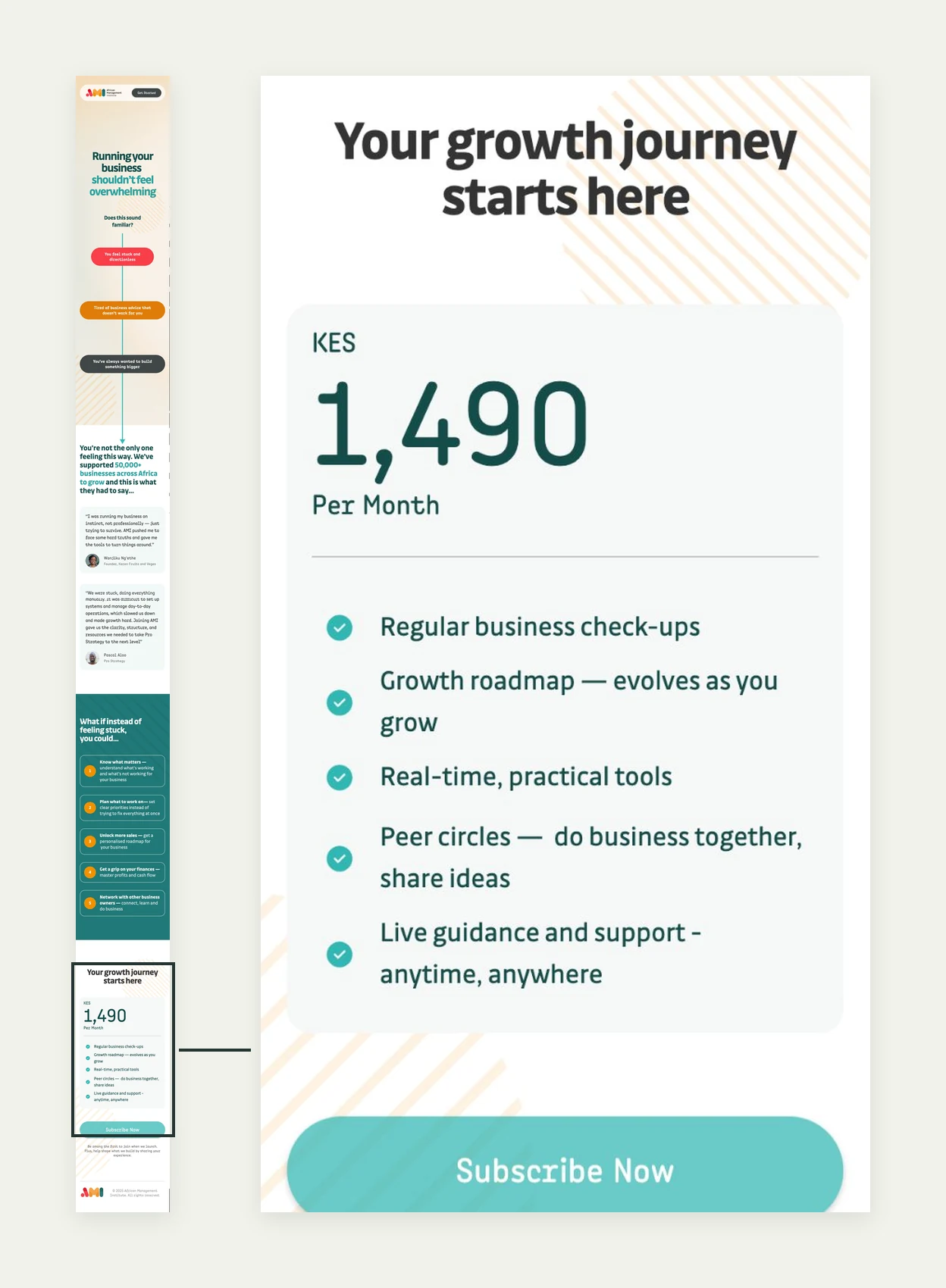
The page asked for KES 1,490 a month, and borrowed its social proof from alumni of AMI's other programmes. It brought in 424 leads against a target of 200. 91% of visitors were on a phone, so the product had to be built for mobile first. Most visitors skipped the top copy and went straight to the sign-up section, and 61.5% came back more than once before signing up. People were interested but not yet sure they could trust us.
The mobile landing page, with the pricing card enlarged. Owners signed up knowing the product would cost KES 1,490 a month.
Solution approach
The PM and I shaped the value proposition, then I designed and built the prototype: a short weekly loop. An owner answers a few diagnostic questions, gets a score and an AI-written insight, picks one small action and records what they found. The next week picks up from there.
I built the test around two rounds of that loop, so we could see whether week two felt connected to week one:
Loop 1, about 15 minutes: 4 diagnostic questions, a score with an AI insight, one action, then capturing what they found.
Loop 2, about 10 minutes: a check-in, 2 questions, an updated score and a new action building on last week.
Debrief, about 5 minutes: how it felt, and whether they would open it again.
An LLM generated the insights live. I designed the conversation and wrote the content that shaped it: a diagnostic to establish where each business stood, then weekly check-ins meant to feel like time with a coach. Testers reacted to what the product would actually say to them.
I tested with 7 SME owners between 21 and 30 January 2026, against four questions. Does it feel like a coach or a form? Are the insights accurate for their business? Does week two remember week one? Would they come back?
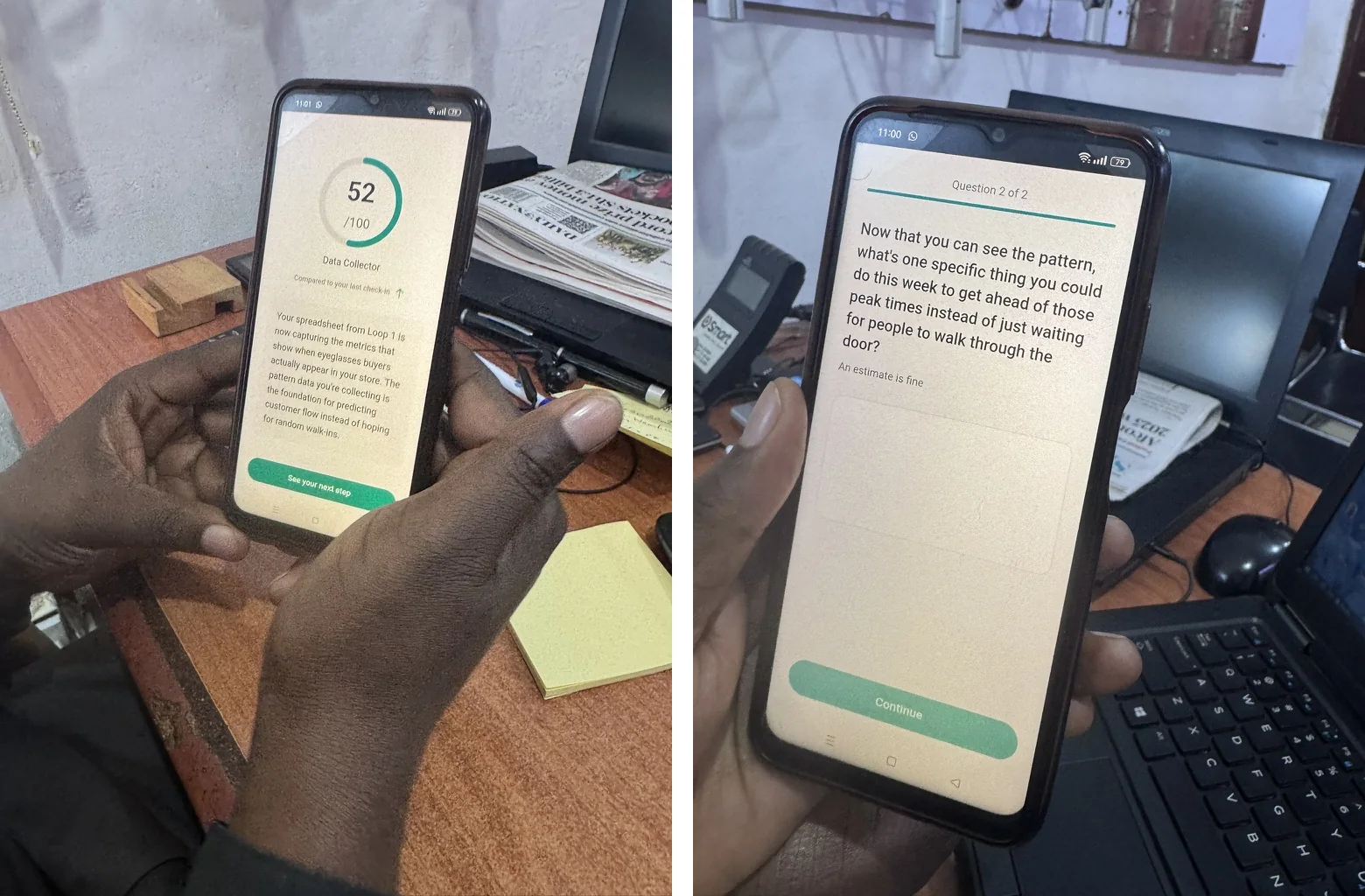
A tester working through Loop 2 on his own phone: an updated score with an insight built on last week, then a follow-up question.
What testing found
The core loop held up. When the AI read the business correctly, owners recognised themselves in the insights. "I almost thought they had background information," one said.
Felt like coaching, not a survey: 5 of 7
Insights accurate for their business: 6 of 7
Noticed week two built on week one: 5 of 7, though 2 needed it pointed out
Would come back: 4 yes, 2 maybe, 1 no
Three things would have broken it at launch:
The AI misread the business model for 2 of 7 owners. It treated a mostly retail business as B2B. When that happened, trust in every other insight dropped.
The "Capture what you found" step confused 3 of 7. That step feeds week two, so confusion there breaks the loop. "This is not clear. What do I need to do?"
Nothing said what happened to their data. "How private is private?" one owner asked, at the exact point we needed them to come back.
The sessions also showed who this is for. Founders 3 to 5 years in, without much operational structure, liked the weekly "homework". Owners with 7 or more years and their own tracking systems saw less value for themselves, though one said he would recommend it to the founders he mentors.
Key decisions
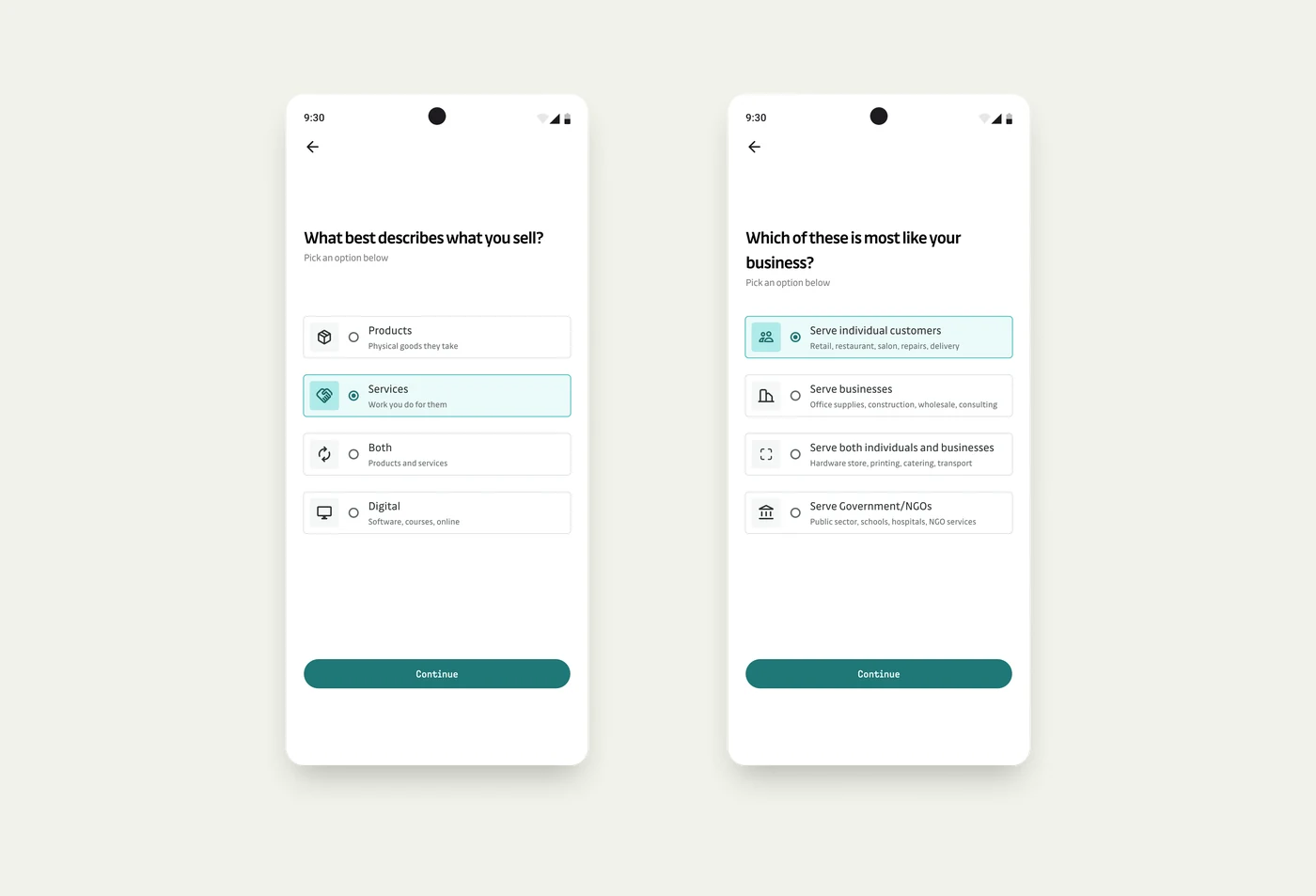
Ask for the business model instead of guessing it. Two direct questions up front: what you sell, and who you sell to. One wrong guess undermined every insight that followed.
Two questions added after testing, so the AI starts from the owner's own answer instead of a guess.
Put an example in every reflection prompt. "What did you discover? Example: 'Corporate clients pay in 7 days'."
Say where the data goes, at the moment of return. "Your data stays private. We don't share unless you choose to."
Make memory visible. "Last week you discovered [X]. Let's build on that." The product already carried last week forward, but 2 of 7 owners only noticed when we pointed it out.
Design for the phone. One question per screen, no PDFs or spreadsheets, chat-style interaction where it fits.
Launch to the segment that wanted it. Newer founders, 3 to 5 years in business, rather than every SME owner.
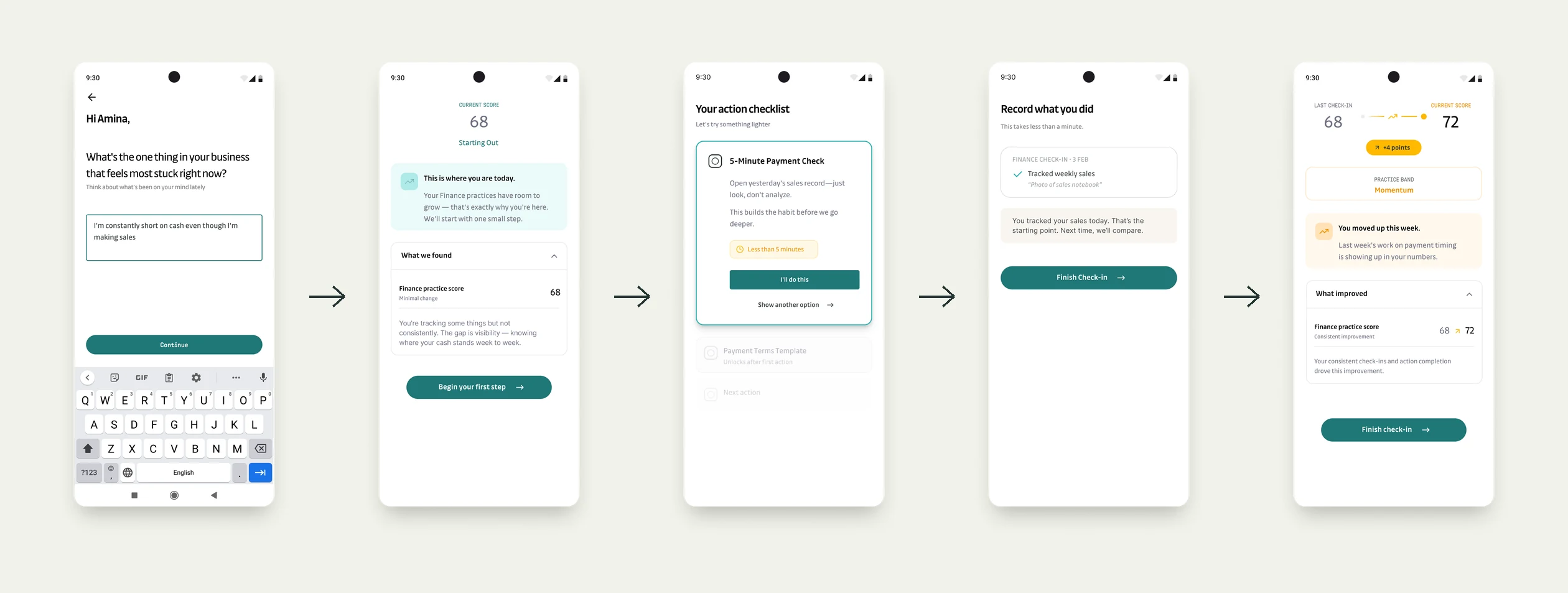
The loop after testing: one small action, a record prompt with an example, and a week-two check-in that names what last week found. Scroll sideways to follow it.
Outcome
The campaign showed demand: 424 leads against a target of 200 in 14 days. Testing showed the weekly loop works for the right owner, and found three launch blockers before any real customer did.
My recommendation was to fix those three issues, launch to newer founders, and measure whether people return in weeks 2 and 3.
Reflection
The 29% misread taught me the most. AI output has to be aware of what the user already knows. A response to a seasoned CFO and one to a new founder are fundamentally different, and that nuance decides whether the product keeps serving the job the user came to it for.